Why a Door Handle Tells You Where to Push
Door handle design makes an unfamiliar entrance easier to read, showing how shape, position and movement help you decide whether to push, pull or slide.
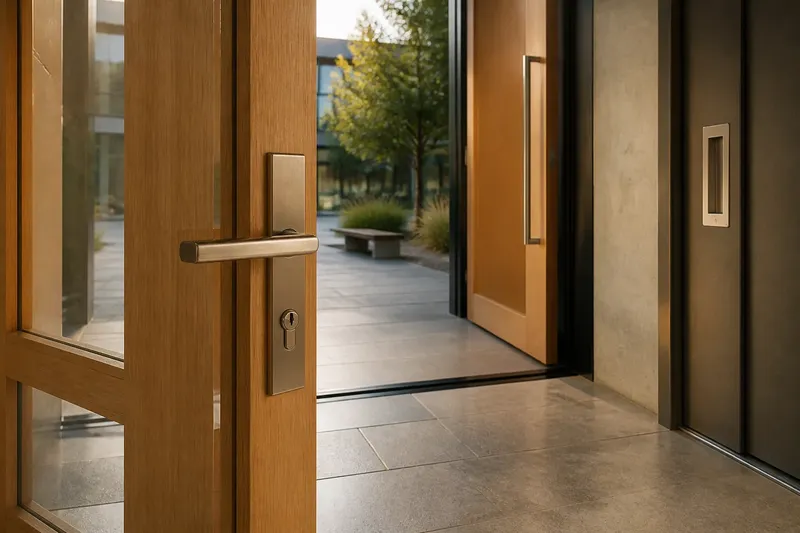
Why does one unfamiliar door invite a push while another asks for a pull? Door handle design offers clues before you touch it: a broad plate, a projecting bar or a recessed grip suggests where your hand should go and what the door may do. Those clues are not a code, but they can make an entrance easier to read.
The useful question is whether the handle’s form, position and movement agree with the action the door needs. A fitting can look elegant and still give poor instructions. The better ones make the next movement feel obvious, without requiring a small negotiation with the door.
Handle cues
A handle gives information through three features: the surface you can grasp or press, its position, and the way it moves. Read together, these suggest whether to push, pull, turn or slide.
A lever gives the hand something to operate, usually by pressing it down. A flat plate offers a surface to push. A recessed cup suggests a grip for drawing a door towards you or moving it sideways. These are ordinary associations, not guarantees; hardware can be installed in ways that confuse them.
Look beyond the handle. Visible hinges suggest which edge swings, while a gap around the panel can reveal its path. A track above a panel hints at sliding movement. The handle is one part of a small system, and the surrounding door may confirm or contradict its message.
Levers and direction
A lever tells you how to operate the latch, not necessarily which way to move the door. It may release the latch when pressed down, while the panel itself swings towards you or away from you.
Use the lever’s position and the door’s construction as additional evidence. If the handle is mounted on a narrow stile beside a broad glazed panel, the broad panel may be the place to push after releasing the latch. If the door has a pull-side lever and visible hinges, pulling may be the likely action. Neither clue is conclusive on its own.
A round knob gives less information about direction. It usually needs a turning action, then a separate push or pull. That sequence can be less apparent, particularly if the knob is awkward to grasp. A lever can be easier to operate without a tight grip, but its shape still does not show the swing direction by itself.
Position and path
Position helps indicate where force belongs. A push plate is commonly placed where a hand can press the panel, often away from the latch edge. A pull handle projects far enough for fingers to get behind it. A recessed cup keeps the grip within the surface, which suits a door that needs to pass close to a wall or another panel.
Consider the edge opposite the hinges. A handle there gives leverage to rotate the door around its pivot. That does not tell you whether to push or pull, but it explains why the fitting is near that edge. A central grip can suggest a sliding panel, where the hand moves it along a track rather than around hinges.
Also notice whether the handle is on your side or visible through glass on the far side. A pull bar on the near face may suggest pulling; a smooth plate may suggest pressing. Public and commercial doors can have paired hardware, so the same fitting may be encountered from either side. The hinges, frame and any directional marking become more useful in that case.
Movement and resistance
Movement is a useful cue once you operate the fitting gently. A lever that turns down releases a latch. A fixed handle that moves with the panel may be a pull. A grip that travels sideways with the panel signals a sliding door.
Do not treat stiffness as an instruction. The door may be locked, held by a closer, caught against its frame, or designed to move in another direction. Forcing it can damage the fitting or startle someone on the other side. Pause and look for a sign, a second handle, a visible track or a clear gap showing the panel’s path.
Some doors combine actions. A lever may need to turn before the panel can be pulled; a sliding door may need a button released first. Separate the task into two observations: what the fitting does, and what the panel does after it is released. The shape often describes the first action more clearly than the second.
When cues conflict
Handles can be fitted for appearance, security or ease of manufacture rather than to explain the door. A long bar might be a pull on one side and a push bar on the other. A plate may cover a latch without being intended as a grip. A decorative ring may look graspable but move only as part of a locking mechanism.
There can also be a mismatch between handle and door. A pull-style fitting on a door that swings away is an awkward invitation, while a small knob on a heavy door offers little leverage. A clear sign, such as “Push” or “Pull”, settles the question more directly than visual inference. Follow any marking rather than assuming the fitting is a perfect diagram of the action.
Accessibility adds a practical consideration. A handle should be reachable and usable without demanding a strong pinch or precise wrist movement. Levers and broad plates can make the action easier to understand and perform than small round knobs, though the door’s weight, closer and clearance also matter. A clear cue helps only if the person using the door can act on it.
Reading a door?
Can a handle show the swing direction?
Not reliably by itself. A handle shows where the hand can act, while hinges, panel gaps and the frame offer better evidence of the swing. Read those cues together rather than treating the fitting as an arrow.
Is a flat plate always for pushing?
No. A flat plate provides a broad surface for pressure, but it may cover another mechanism or sit on a door that opens in either direction. Look for a pull fitting on the opposite face or a clear instruction.
What does a recessed handle suggest?
A recessed cup gives fingers a place to pull or slide without a projecting handle catching on nearby surfaces. Whether the panel swings or slides depends on its hinges or track, not on the recess alone.
What if the door will not move?
Stop applying force and check for a lock, closer, sign or obstruction. If the direction remains unclear, ask someone responsible for the entrance rather than risking damage or opening the door into another person’s path.
Reading an unfamiliar door
Start with the whole assembly, not just the most conspicuous piece of metal. Check for a sign, then look for hinges, tracks, a gap at the panel edge and the shape of the fitting. If the direction remains unclear, try the indicated control gently and stop if the door resists.
- Check for words or symbols. If a sign says push, pull or slide, follow it; if there is no sign, inspect the panel and hardware before acting.
- Check the hinges. If they are visible, use their position to identify the pivot edge; if not, look for another clue rather than guessing from the handle alone.
- Check the grip. If the fitting is a plate, consider pressing it; if it projects or has a recess, look for a safe place to pull without assuming that is the panel’s direction.
- Check for a track. If a track or overlapping panel is visible, consider sideways movement; if neither appears, look for hinges and a swing gap.
- Check the latch. If a lever or knob needs turning, operate it gently before moving the panel; if the panel still resists, stop and check for a lock or obstruction.
- Check for resistance. If the door moves freely in the indicated direction, continue carefully; if it resists, stop and reassess the signs, hardware and panel path rather than adding force.
Say you reach a glazed door with a horizontal bar and no sign. Imagine the hinges are visible on your side and the bar sits near the opposite edge. First, you note the hinges to identify the pivot; next, you check whether the bar offers a secure grip and whether the glass shows a gap along the panel’s path. You try the bar gently. If the door begins to move towards you, the observable result is a pull; if it stays firm, you stop and look for a lock, closer or instruction instead of pulling harder. The trade-off is a brief pause rather than risking damage or an unexpected opening into someone’s path.
Where cues matter
Visible cues matter where a person cannot rely on familiarity: a station corridor, a shared office, a shop entrance or a door encountered from an unfamiliar side. A fitting that communicates its action can reduce hesitation. It is a small contribution to the design of a place, but one encountered at arm’s length.
If you are choosing or reviewing hardware, compare the signal with the action on both sides of the door. Ask whether the shape suggests a grasp, press or turn, whether the panel’s direction is apparent, and whether the handle remains usable when the door is open or the nearby area is crowded. Manufacturer instructions and local requirements matter when selecting or changing hardware. For structural or safety-critical alterations, consult a qualified professional.
Door handle design is clearest when the fitting and panel tell the same story. A bar should offer a convincing grip, a plate a useful place to press, and the door itself a visible path. When those clues disagree, a pause is better than a flourish of force.